May 31, 2004
Help Support Dahr Jamail for Another 5 Weeks of Courageous Reporting
After nearly two months of generating some of the most compelling journalism to come out of Iraq this year, NewStandard correspondent Dahr Jamail has decided to stay on through the June 30 "handover" of partial sovereignty, adding more than a month to his work in Iraq and his witness to a crucial moment in modern Iraqi history.
We are of course pleased and honored to continue to be the primary outlet for Dahr's writing, as well as his main source of financial, editorial and other support.
So that Dahr may continue his invaluable work in Iraq, we once again call on his readers for generous financial backing.
With the help of hundreds of donors -- people just like you who appreciate truly independent, noncommercial coverage of the crisis in Iraq, and donated what they could afford -- The NewStandard has so far been able to assist Dahr Jamail in the following ways:
1. Financial support - The NewStandard has raised over $6000 to pay Dahr's expenses for two months of living and working in a particularly dangerous war zone. We also pay Dahr as much as we can afford for each hard news article he writes for The NewStandard.
2. Editorial support - A great deal of the research that goes into Dahr's reports is actually carried out stateside by his editors.
3. Publishing services - The NewStandard hosts a weblog for Dahr and publishes most of his original news items, then mails them out to numerous other publications.
4. Re-printing services - We readily grant permission for Dahr's work to be republished freely by other nonprofit outlets, exponentially increasing his exposure.
So far, because of the help of generous donors, in less than 2 months Dahr has:
1. written 27 compelling "weblog entries," which are really field reports based on hours of research -- many websites are re-posting these as full-fledged articles;
2. written 16 full-length hard news articles, professionally edited by NewStandard staff, including coverage from inside the Fallujah siege when almost no Western journalists would venture into the city, plus many other stories on subjects Western reporters won't touch;
3. given dozens of interviews with radio stations and newspapers all over the world;
4. written commentaries for ZNet and numerous short articles for mass outlets such as Inter Press Service and Islam OnLine;
5. taken hundreds of high-impact photographs, many of which will appear in the slide show Dahr uses for visual presentations on tour in North America.
None of that could have happened without the support of readers who appreciate Dahr's skills, initiative, methods and authentic perspective.
PLEASE help us support Dahr for another 5 weeks of important efforts as our eyes and ears on the ground in Iraq. We hope to raise at least another $3500 to enable Dahr and The NewStandard to continue bringing you the amount and quality of coverage you've come to expect. That amount includes $750 for a new plane ticket since his existing return trip ticket can't be exchanged.
The kind of support Dahr deserves for the dangerous and stressful work of bringing us a vital, underreported side of the Iraq story requires a substantial amount of money, though Dahr has found ways to manage on a mere fraction of the budgets other war correspondents require.
Every donation makes a difference. $10 pays for Dahr's meals for a day, or his transportation costs to gather a story; while $500 pays for the gathering, writing, editing and promotion of a whole news story. Even if you cannot afford to donate much yourself, passing this notice on and convincing friends and relatives to donate would be of great assistance.
See Dahr's contributor bio page for a complete list of articles he has written for The NewStandard.
If you are able to help keep Dahr safe and active in Baghdad for the next 5 weeks, please go to our highly secure web page and donate whatever you can afford. The NewStandard and Dahr Jamail greatly appreciate any help you can provide.
Checks or money orders can be made out to PeoplesNetWorks and sent to:
PeoplesNetWorks
203 Bassett Street
Syracuse, NY 13210
Please also forward this email widely to friends, family, websites and listservs.
For more information, feel free to write or call the NewStandard's Middle East Desk:
email: brian[[at]]peoplesnetworks[[dot]]net (spam guard: change [[at]] to @ and [[dot]] to . )
phone: 315-885-9649
Disintegration
Late night writing due to the sweat alarm that has gone off, shortly after the electricity has cut out yet again. The electricity seems to have gotten worse lately, which is not surprising, in that this coincides with the gas shortage -- also growing more severe by the day.
So many things leave imprints on me as I go through the day here, it has grown nearly impossible to jot them all down. One of the reasons I’ve written fewer blogs this trip has been because it has been overwhelming. The situation is so much worse now than when I was here in December and January. And it was bad then, to be sure.
During an interview earlier today with a young Sheikh who is very much a Sadr supporter, I asked him what he would do if Muqtada Al-Sadr was captured or killed by the US military. I wondered if the seemingly unorganized followers and ill-trained militia would disintegrate and fade away.
He pulled his 6 year-old daughter forward, her cute smiling face proudly beaming from under her small hijab, and asked her my question in Arabic. Her reply: “We will always follow Muqtada Al-Sadr.”
It reminded me of another occurrence that left an impression on me my very first day in the field here this trip, at the beginning of April.
I was in Sadr City the day after some heavy fighting between the Mehdi Army and US forces, and was talking with an American tank crew. Two of the men were sweeping debris off the top of their tank, which had the few portals of its glass smashed. What other loose pieces on the tank had been torn off and were laying on the ground. Rocks were everywhere.
One of the soldiers told me a group of around 200 kids had surrounded them and pelted them with stones. All they could do was sit inside and ride it out.
He went on to tell me that he was a bit shaken up by it saying, “They are just kids, and we are a tank!” So the kids were attacking them during the day, and the men from the area attacked them at night with Kalashnikovs and RPGs.
My friend Aziz came by this afternoon... shaken. He told me that there had been an assassination attempt on Ismail Zayer, the editor of the New Sabah, a newspaper Mr. Zayer founded after breaking ranks with the CPA controlled Sabah newspaper. According to the story, a group of men in four cars, one of them an Iraqi Police vehicle, showed up at Zayer’s office and told him the Minister of the Interior had requested that he accompany them to his office.
Zayer told them he needed to change and went inside to call the Minister to verify this, as he knew the Minister personally. The Minister told him he did not order this, and did not know what it was about.
Meanwhile, Mr. Zayer’s driver and body guard were taken away by the men, later to be found shot in the head.
I’d seen Zayer’s body guard: a large man with a pony tail-not many Iraqis have pony tails. He was very friendly when I’d gone there to interview Mr. Zayer a few weeks ago. Even though he wasn’t a friend, just someone I’d met, it is always difficult to reconcile that someone I know is gone now. And not just gone, but shot in the head.
So it’s happened to me now. That which has happened to every Iraqi friend of mine. Everyone here knows someone personally who has died an untimely death.
Ater telling me about this horrible story, Aziz said, “It is getting worse by the day here.”
How is life possibly going to get better in Iraq? Kids are being raised to fight against the most powerful military the Earth has ever known. Every U.S. soldier who comes here knows they will be in-country for at least one full year. More troops are on the way. More soldiers have been killed near Ramadi and Fallujah recently. The truce in Najaf and Kufa came and went. A man has been selected by the IGC as the president whom every single Iraqi I know thinks is an absolute bastard.
One man I know, when asked what he thought about Alawi, said frankly, “He will be killed, insh’allah.” Another Iraqi friend said, “If he lasts a month, he’ll be very lucky.”
So as the Bush and Blair camps race about trying to paint a picture of stability and structure in Iraq, with June 30 is now just a month away -- this place is coming apart at the seams. For each step forward the coalition makes, two disasters occur... whether they take the form of deadly attacks on the occupying forces, more mortars blasting into the CPA, sabotage of a pipeline or powerplant, a murder, another SUV of secret service or security mercenaries taken out by an RPG, or something less obvious...
A child being raised to fight. A woman dying of breast cancer from depleted uranium exposure. A highly trained engineer, without work, sweating in his car, which he drives as a taxi, which means waiting for hours in a fuel line. A family home raided in the middle of the night by the military. Women not being able to leave their homes in safety. Nor men, for that matter. A soldier who has lost his legs in an IED blast goes home to his country. He and his family having to learn to live with his disability. An Iraqi war veteran begging on the street -- has no family.
Iraq has been shattered. And now, today, over a year since the horrible regime of Saddam Hussein was overthrown, what is left of the country seems to be unraveling more and more with each passing day.
May 29, 2004
Daily Life
Sometimes I forget that burnout applies to me too. After nearly two months straight of chasing stories, it was obviously time for a break. Unlike home though, one can't go take in a movie, take a jog or even a casual stroll. Walking around anywhere in Baghdad, being a westerner, is never casual. So I've spent most of my day off inside.
I asked one of my Iraqi friends what most Iraqis do to relax nowadays, and he said about all there is to do to relax is to sit around and drink tea. He said, "I used to go swimming a lot, but the local pool got bombed during the war, so I haven't gone swimming lately."
He used to go out with friends late into the night, before the war. "We used to start the evenings at 8 p.m., but now we have to end them by 7," he tells me.
So a relatively calm day in Iraq today... this roughly translates to more sporadic fighting in Kufa where US troops killed several Iraqis, the naming of a new Prime Minister who nobody voted for, two Japanese journalists being killed when their vehicle was hit by a Rocket Propelled Grenade and a tenuous "truce" in the works between coalition forces and Muqtada Al-Sadr.
The tenuousness of the entire situation isn't helped by the machinations going on prior to the June 30 "handover." What happens next here is anybody's guess.
It's been interesting watching the new influx of retail goods: Pepsi, 7-up, and Coke are all here in force. Snickers, Toblerone, and other western products as well...but the most obvious are the huge stacks of air conditioners, refridgerators and small generators that tend to form small canyons along the streetsides of Karrada and Arasat, among others.
What other "progress" can I report? A journo friend visiting a mutual friend of ours in Baqubah gave me a ring on the cell tonight -- so the cellular service now includes Baqubah, which is about 30 miles northeast of Baghdad.
Yet another gas crisis has hit Baghdad. Due to the oil pipeline which feeds the refinery at Al-Dora being blown up on May 12, production has dropped a bit here since Dora provides roughly 30% of the gasoline for Iraq.
Some of the gas lines are now over 5 kilometers long, and Iraqis are NOT happy about it. Sitting in their cars for hours on end in 110 degree temps isn't exactly helping things here, and most Iraqis (remember the 60% unemployment rate) can ill afford to pay the 5-10 times higher blackmarket rate to fill their cars or jerry-cans for their generators (remember that electricity is still far below pre-war levels).
I was contemplating going to Basra in June with a colleague, and told my translator Abu Talat about it. In shock he said, "You want to go to Basra?" I told him I was thinking about it, why? "It's not hot there, It's HELL!" He was referring to the heat... which if it's that much warmer than Baghdad, I may have to reconsider. Hopefully, insh'allah, there won't be another gas crisis here in July or August.
That's enough of my random thoughts for tonight -- time to get some sleep while our generator is still powering the air conditioner. It's been going out at nights now because of the gas shortage... so a few hours of good sleep before waking up sweaty is calling my name.
May 27, 2004
Slaughter in the Streets
Seventeen year-old Amir is crying during much of the interview. “We were coming home from work, and were shot so many times,” he says with deep anguish and frustration, “Walid told me to leave the car because he was hurt and needed help.”
The man he speaks of, Walid Mohammed Abrahim, was a carpenter. Amir worked as his apprentice.
On May 12th, U.S. troops occupying an Iraqi Police station in the Al-Adhamiya district of Baghdad gunned down their small car as they traveled home after a long day of work.
“I still can’t believe Walid is killed,” said Amir, crying inside the home of Abrahim’s brother. “He is like my brother, was so decent and honest. So many people are killed because of their crazy, haphazard shooting.”
He is referring to the U.S. troops who riddled the car with over 25 bullets. While they were driving past an Iraqi Police station, a rebel fired upon the station from a building on nearly the opposite end of the station from where their car was. Mr. Abrahm’s car being the closest moving object, the soldiers chose it as the most convenient suspected target.
Mr. Abrahim’s brother, Khalid Mohammed Abrahim, sitting with us in his home today is beside himself with anguish, “All my brother was doing was coming home from work.” He says that his brother was a kind man, with no involvement in the resistance, and did not even own a weapon.
Another man sitting with us who is a resident of the neighborhood, 31 year-old Mohammed Messen, spoke of the slaughter of an innocent man that he witnessed. “I saw coalition troops firing haphazardly and Walid was killed by them,” he stated sadly. “I give this testimony to show that coalition troops shot him.”
Khalid then suddenly added: “Why has my brother been killed? They searched his car and know he was innocent. All we seek is for God to give us patience to deal with such conditions.”
He then looked at the ground and breathed, “We are all suffering here.”
Later on that afternoon, I go to the home of an Iraqi Policeman who was at the station that night and agreed to discuss the incident on condition of anonymity. He says Mr. Abrahim was returning home when he passed the police station in Al-Adhamiya at 2 a.m. Due to celebratory gunfire earlier in the night following an Iraqi Soccer Team victory, U.S. soldiers occupied the Iraqi Police station in the district.
The police report of the incident states that his car was shot 29 times, with Mr. Abrahim suffering two gunshots in the head, along with being shot five times in the chest.
Another Iraqi Policeman who was at the station when the incident occurred, also speaking on condition of anonymity with us, says that when several men attempted to pull Abrahim from the car, U.S. troops opened fire on them. “This is the usual policy of the Americans,” he states as a matter of fact, “They always shoot first, because there is nobody to punish them for their mistakes.”
He says that Iraqi Police have no control over their station when the U.S. forces choose to occupy it. “When the Americans take over our police station, they bring us all together and tell us we are no longer in charge of anything,” he says, holding up his arms in exasperation.
The policeman says that all of them were made to stay inside the station while U.S. soldiers occupied the roof. “This is why I can say definitely yes, it was the Americans who shot Mr. Abrahim, and not Iraqi Police, because none of us were even allowed on the roof,” he says firmly.
He adds that he personally has on his desk between 150-200 files of incidents where U.S. occupation forces have killed innocent Iraqis, and that several other Iraqi Policemen at his station have a similar number. He lets out a deep breath and says, “There are so many people the Americans have shot.”
Continuing his discussion of the atrocity, he says, “When I reached near to the car, I saw people trying to pull him out of the car, but the Americans began shooting at them so they ran away.”
When he was finally able to reach Abrahim, he found he had died of his wounds. He then attempted to take the body to a nearby hospital, along with Amir and two other witnesses at the scene. “We tried to leave but several Humvees appeared and shot at us,” he says loudly, “even though we were in a police car.”
The policeman goes on to say that after the troops ceased firing, he told them they had a body, but was told to go another way to the hospital.
Horrendous as this story is, accounts of its kind are not infrequent today in occupied Iraq. In fact, events like this have become commonplace. Driving anywhere in Baghdad on any given day, the black funeral announcements of untimely deaths are hanging from buildings, homes, and fences everywhere.
Not that these ever make it into Western media.
As General Tommy Franks who directed the invasion of Iraq said, “We don’t do body counts.”
May 24, 2004
Dreamers...
Decades of smiles have left crinkles on his face that belie the sadness deep within his eyes. His hope and love for America has turned to a despair he is unable to express.
“I want to talk to an American general or judge,” says Nihad Munir. “I will give them my guarantee that my son is innocent. I will tell them that if he is not, then they can take me.”
His son, Ayad Nihad Ahmed Munir, was detained from their home during another of the middle of the night home raids the U.S. military is so fond of conducting in occupied Iraq. That was on September 28, 2003. Ayad remains in Abu Ghraib today, and his father has not been allowed to visit him, despite trying everything he can think of to do so.
Of course, as usual, Ayad, married with three children, wasn’t charged with anything.
Mr. Munir carries a small brown satchel, which holds copies of paperwork ... the fruits months worth of his futile attempts to break down the untouchable barrier that bars him from seeing his son.
Here is a verbatim transcription of his written account of what occurred:
“On late night 27/28 September 2003 My own house/sons house has been attacked in a very bad and severe unrespectful manner by the American Military Occupation Forces regardless to our Islamic and Iraqi Holy Family Traditional safety and security manners. Claiming they received information about strangers hidden in this living area who are in touch with the recent explosives accidents occurs near the main Highway connecting Abu Kharib Amiriaa/Shouala close to hour house. They put us outside our main gate entrance (I and my sick wife of over 70 years, my son Ayads’ wife and three children, in deep sleep took them out of bed). Our two houses were both thoroughly and too repeatedly inspected for 3.5 hours. Finally they took away along with them my son without explaining the main accusation or charge. This incident resulted to: Losing cash money (son owns $1500 US), three women and men’s handwatches. My sons ID Card, his own passport, N. 459835 issued 3/5/2001 valid until 2/5/2005, and food stuff form NO. 863553.”
Mr. Munir has visited America. His dream is to return there again someday. “I’m a 65 year-old man, do you think I’m too much a dreamer?” he says with a hopeful smile.
I tell him, “Of course not…where are we without our dreams?”
I’m trying not to cry as I tell him this…because in Iraq, for Iraqis today, for Mr. Munir, this is all he has right now.
“I had a brother in Michigan who I so wanted to visit in the ’70s ... but he died,” he continues while pulling out a copy of his son’s passport to show me a handsome photo of the detainee. “I visited America, I know Americans are very friendly people.”
His soft, kind voice hides his anguish. While distraught with the actions and behavior of the U.S. military in his country, he still separates this from the populace of the country which produced it.
Smiling gently, he adds: “See my hope? I still want to go to America.”
But the brief interlude of dreams dissipates as the reality at hand sets back in. He shows me a form he’d filled out from the Islamic Party -- another document so far proven useless for obtaining contact with his son.
Then there is the letter signed by tribal sheikhs that he wrote last January, when the CPA was granting the release of some prisoners if their tribes swore to be responsible for any crimes the freed detainees may commit. Another useless document.
Mr. Munir’s despair returns: “We are lost! Our Iraqi lawyers are useless, because to the American military here, everything is about U.S. security.”
With gracious thanks he shakes my hand for making the time to visit with him. “I am so grateful for you for talking with me about my son,” his other hand is placed upon mine which he continues pumping. “Anything you can do will be most helpful for us.”
And now I’m in that position I dread again, as I explain to him that I am only a journalist; that although I will write about his story, I don’t know what else I can do to help his son.
Iraqis aren’t the only ones who are powerless in their country today. I hate this feeling ... having someone hold hope in my writing ... that it might actually change something for them. I never know what to do with this feeling.
The talk with Mr. Munir softens the anger I’ve felt so often towards the injustice which is slammed in my face every day here. The gentleness of his soul, despite his “critical time,” as he calls it, touches the deep sadness that lies beneath the false exterior of anger that usually covers it.
The rest of the evening I am sad. I think of how beneath the fury of the fighting of Fallujah in April, lies a bottomless ocean of sadness here. Under the bloodshed and fighting that rages in the South even now, there is unfathomable grief.
Driving back home with Abu Talat I phone my parents and tell them I love them. We laugh some, they speak with Abut Talat in parental solidarity, and we laugh a little more.
I hang up the phone and stare at the silhouettes of palm trees, the stars, the sliver of moon, and breathe deep so as not to cry ... because of Mr. Munir.
“Do you think I’m too much a dreamer?”
May 23, 2004
The More Things Change…
With the recent court-martial trial of one of the soldiers complicit in the widespread torturing of Iraqis in Abu Ghraib prison having come and gone, Iraqis see the newest promise made by the U.S. -- to clean up their act regarding the treatment of detained Iraqis -- as being yet more empty words.
In the dark humor that has become so popular in Baghdad these days, one recently released detainee said, “The Americans brought electricity to my ass before they brought it to my house!”
The promises to bring justice to soldiers involved in these heinous acts, along with promises to make Abu Ghraib more transparent and accessible, have fallen on the distraught ears of family members who wait outside the gates of the prison to see their loved ones inside.
Yesterday I went to the dusty, dismal, razor-wire ensconced waiting area outside of Abu Ghraib. Amidst the distinct feeling of despair and hopelessness pervading the heavily guarded area I found one horror story after another from melancholy family members, hoping against hope to be granted their chance to visit someone inside the awful compound.
Men, women and crying children congregated at this dire patch of barren earth, expressing bewilderment and outrage at their continuing inability to visit or gain information about loved ones held inside.
Sitting on the hard packed dirt in his white dishdasha, his head scarf languidly flapping in the dry, hot wind, Lilu Hammed stared at the high walls of the nearby prison. It was as if he was attempting to see his 32 year-old son Abbas through the tan concrete.
He sat alone, his tired eyes unwaveringly gazing upon the heavily guarded Abu Ghraib. When my interpreter Abu Talat asked him if he would speak with us, several seconds passed before Lilu slowly turned his head to look up at us.
“I am sitting here on the ground now, waiting for God’s help.”
His son had been in Abu Ghraib for 6 months following a raid on his home which produced no weapons. He had never been charged with anything. Lilu held a crumpled visitation permission slip in his hand that he had just obtained which allows for a reunion with his son ... on the 18th of August.
Lilu, along with every other person I interviewed there, had found consolation neither in the recent court martial or the recent release of a few hundred prisoners.
“This court-martial is nonsense. They said that Iraqis could come to the trial, but they could not. It was a false trial.”
As for the recent release of several hundred prisoners from Abu Ghraib, he added: “I know someone who was captured for counterfeiting money, and they were released. So the thieves are released, and my innocent son is still inside!”
Another man tells of his brother, Jabbar Atia, who was detained without a reason given by the U.S. military.
“I don’t know why he is here!” he says in despair. “Even my brother does not know why he is here. Please tell me why! I am always coming here waiting for him to be released, but it never happens.”
He, too, feels the court-martial trial was bogus, and said: “It was a false trial. The Americans are only interested in capturing Iraqis. They don’t care about the facts.”
Yet another horrible story is that of Tu’amaa Mola Hassan Sabeeh, a 67 year-old man with Alzheimer’s, who had wandered from his home in Baghdad on June 29, 2003, and has been missing ever since.
His son, Rassem, standing in front of the checkpoint of Abu Ghraib, said, “We searched all of Iraq for him, and couldn’t find him. Then three weeks ago someone who was released told us he was here.”
Now the family members take turns coming out and waiting for his release. “We have not been allowed to see him, and if he is released, he can’t remember where to go, so we need to come here everyday to wait for him in case he is released.”
He said the entire family is affected, as the time away from their jobs is draining them financially. He added, “We’re all crying now. All our time is spent waiting. We don’t know his number, since they use numbers instead of names in there. So we know he’s there, but we cannot contact him. Where is the justice?”
Another man whose nephew is inside the prison, said, “I was depressed to see that my nephew remains in jail while others are released.”
When asked about the trial, he laughed deeply, then collected himself and said, “It was a movie. It was not real.”
The mother of Sadiq Abrahim was despondent when discussing both the detention of her 20 year-old son, as well as the recent trial. “An Iraqi judge had already found my son innocent, but he is still in jail,” she said. “I was happy to see the other prisoners released, but it made me sadder for my son.”
Of the recent trial in Baghdad she commented: “None of us believe the trial. It is not a real punishment.”
According to the mother of another prisoner, Jilal Samir, her son Habib was walking down the street when he was looted by thieves. Habib found some U.S. soldiers to ask for help, and was detained immediately. “He has been in jail for 10 months now, and what did he do to be here? Where is the justice?”
With tears in her eyes she told of trying to reason with a soldier while attempting to gain access into the penitentiary. She asked him if he would feel sad if he had a mother and couldn’t see her, and the soldier, in a smug effort to dismiss her plea, replied, “No.”
Holding her hands in the air, with more tears she cried, “Do the Americans have no feelings? They may not feel, but we do!”
Another convoy of Humvees full of soldiers with their guns pointing out the small windows rumbled out of the front gate of the penal complex. The huge dust cloud they produced quickly engulfed everyone waiting at the checkpoint.
Mrs. Samir, waved away the clouds of dust which billowed around her face. “We hope the whole world can see the position we are in now!” she said.
Meanwhile, in a press released on May 21st: “The Coalition Provisional Authority has recently given out hundreds of soccer balls to Iraqi children in Ramadi, Karbala, and Hilla. Iraqi women from Hilla sewed the soccer balls, which are emblazoned with the phrase All of Us Participate in a New Iraq.”
From Ann Arbor to Beirut
I meant to link to David Enders' blog, From Ann Arbor to Beirut. I came across it a while back but it slipped my mind. David is a freelancer writing for lots of different outlets, and his work is both insightful and compelling. Aside from his great blog entries, David posts goodies like this audio recording of an impromptu poetry reading (mp3 file) by a soldier he met. Be sure to check it out.
May 21, 2004
The Seeds have been Sown
“Iraq is sitting atop a volcano,” says a school teacher in Haditha. “The Americans are aggravating people here, trying to get a reaction. Everyone in this province is against them now!”
Most Iraqis I speak with nowadays are seething with rage towards the occupiers of their country. With their mosques being raided, damaged or destroyed on what has become a nearly daily basis, they have had enough.
Then, as if the unremitting stream of horrendous photographs documenting the widespread torturing of Iraqis within Abu Ghraib prison (among other detention facilities throughout Iraq) are not enough, the recent wedding party massacre has brought the fury to an entirely new level.
The continuing cultural insensitivity and unwillingness to take responsibility for the slaughter by the U.S. military is not helping ebb the rage felt by Iraqis about the incident.
While Arabic media has shown footage of the mangled bodies of the 25 women and children killed by U.S. helicopters, Marine General James Mattis in Fallujah responded:
"Ten miles from Syrian border and 80 miles from nearest city and a wedding party? Don't be naïve. Plus they had 30 males of military age with them. How many people go to the middle of the desert to have a wedding party?"
Someone should inform General Mattis that most of Iraq just happens to be located in a desert, and that celebrations of all kinds in the desert are not uncommon here.
On the banks of the Euphrates River inside a humble home in Haditha, Mr. Tahrir, a manager of one of the local schools, is unable to contain his anger while discussing the countless atrocities committed by the U.S. and British militaries as of late.
“So a few soldiers get court-martialed for abusing Iraqis. They get a fair trial, then maybe a year in jail. Is this fair? Iraqi civil rights lawyers, human rights organizations, and released detainees who were tortured weren’t even allowed inside of the show trial!”
Mr. Tahrir, and all of the other men and women I am drinking tea with, is unable to accept the incongruity of justice as applied to soldiers vs. detained Iraqis. Most detained Iraqis have never been charged with anything, have no access to a lawyer or their families, no phone calls, and as we can see every day now, are being treated horrendously.
How would people in the US react if shown pictures of Americans imprisoned by a foreign military that showed the detainees being forced to simulate degrading sex acts, being covered in feces, ridden like animals, handcuffed to their beds with underwear on their heads and being attacked by guard dogs?
The signs of continued violent resistance to the occupation are obvious even as one drives out of the quiet town of Haditha, beautifully set amidst palm trees, green fields of vegetable crops and the mighty Euphrates flowing past. For the road just outside of the city has huge craters along the sides, blasted by Improvised Explosive Devices detonated while U.S. convoys passed.
Iraqis aren’t the only people suffering. Just in the last two days, five more U.S. soldiers have been killed, and at least twice that number wounded. Heavy fighting rages throughout southern Iraq, which of course is claiming even more civilian casualties than fighters on either side.
Driving back to Baghdad finds the usual delays from military convoys and checkpoints. Iraqis are not getting used to being delayed by the foreign militaries in their country, as cars honk and tempers rise with each passing minute. In Baghdad, according to General Kimmitt, currently 76 roads are blocked for “security reasons.” Snarled traffic in the capital is a daily fact of life, people sitting in their cars, their anger rising along with the 100 degree temperatures.
West of Fallujah on the main highway, while racing towards Baghdad alongside the setting sun, there are countless military vehicles sitting sporadically along the sides of the road.
We pass a few small cemeteries, which oddly enough have Humvees and soldiers sitting beside them. Not good PR with the Iraqis.
Even though the military claims that an “attacker fired on the patrol from a cemetery” north of Baghdad in Miqdadiya recently, most Iraqis are unaware of this; only seeing Humvees parked atop the bodies of their dead; Humvees from the same military that is regularly damaging and raiding mosques in Baghdad and southern Iraq. Humvees from the same military which just slaughtered 40 people at a wedding celebration.
Shortly after passing these, Fallujah is on our right -- along with the token US checkpoint on the main street that enters the city from the highway. While members of the Iraqi Civil Defense Corps actually operate the checkpoint, a few Humvees are parked off to the side under camouflage netting, discreetly incognito.
The checkpoint maintains the US military illusion of control over the one truly liberated city in occupied Iraq, as their patrols no longer enter inside.
Recently Mr. Bush said, “And I believe the Iraqi people don't want to be dominated by anybody. They want the United States to be a friend, but the United States to not dominate.”
His quote reminds me of something Mr. Tahrir told me earlier in Haditha whilst speaking of the US occupation of his country. “They promised prosperity, yet they have destroyed everything. They said they’d bring real freedom; but we see our people in prison, tortured, looted and homes raided.”
Tassin Awad, sitting nearby, nodded in agreement and added, “I would like to see Mr. Bush and tell him that Saddam is better than he is.”
May 17, 2004
Ramadi-A Delicate Lid
The city of Ramadi, about 120km west of Baghdad, appears to be much more stable than nearby Falluja, where the U.S. military currently won’t enter the city after the failed siege of April.
Here U.S. military patrols still roam the streets and attacks seem to be down. Both the Governor of the vast Al-Anbar Province and the Commander of the Iraqi Police (IP) are hopeful about the recent calming throughout the area.
In the heavily fortified building in central Ramadi which houses the Governor of the Al-Anbar Province Mr. Ezzedin Abdul Kareem, he is upbeat about the situation, despite having had three assassination attempts in the last year.
“Both Ramadi and Falluja are extremely tribal,” he explained while discussing why things have gone more smoothly as of late in Ramadi. “But Ramadi is closer to Baghdad and the people of Ramadi are more influenced by their religious leaders.”
He stated that there are good relations between the Coalition Provisional Authority (CPA), and the government structures of Ramadi, and that in addition to the $500 million the CPA plans on spending to rebuild in Ramadi, there is now another $70 million earmarked for Ramadi and Falluja.
While he said the payment is to be issued in one lump sum, the actual delivery of this money has yet to occur.
What is worth noting as another reason why the situation in Ramadi remains relatively stable as of late is that on April 11, 2003, Governor Abdul Kareem was elected as governor by a council of Sheikhs. In addition, he is extremely well respected throughout Ramadi.
Nevertheless, he was surprised at how well the formation of the councils in the cities and villages throughout Al-Anbar had gone this past January. Even though the caucuses were set up by the CPA, many people have still felt a fair degree of autonomy in that it was their own tribal leaders selecting their governor and other council members. This differs greatly from the appointing of the Iraqi Governing Council (IGC) members by the CPA.
In sum, the governor said, “The people asked me to be in this position.”
It is safe to say that in Iraq today, I’ve been hard pressed to find anyone who supports the IGC. If you want to anger an Iraqi, mention the occupation or the IGC.
Jaadman Ahmed Al-Awany is the Commander of the Iraqi Police of Al-Anbar Province, and in charge of 10,850 IPs. He agrees with the governor that the sheikhs and religious men have helped to calm the volatile situation in Ramadi. “There have been less attacks on IPs here the last few months because so many of them come from this area, and are being better equipped than before,” he said.
Nevertheless, two IPs had just been killed in Ramadi prior to our interview.
One must not forget that calm is a relative term in occupied Iraq.
Today was the meeting of all the city IP commanders from throughout the province. Colonel Sabar Fahdil is the Commander of the IPs of Falluja, and openly expressed his anger towards what occurred in his city during April.
“The Americans used the execution of the four American contractors there as an excuse to surround and attack Falluja,” he said angrily. He lamented over how helicopters and warplanes were used to bomb civilians and homes. “They killed over 1200 Fallujans!” He continued, “I was there negotiating with the Americans, but they broke the ceasefire so many times.”
After a huge lunch and pleasant goodbyes, out on the street the mood was anything but calm.
One shop owner named Sfook, when asked if he felt things in Ramadi were more stable nowadays said, “It’s not safe here, for Iraqis or Americans. The Americans attack our homes so much, whether there is a reason or not. The problem is the Americans’ presence here. We will never accept the occupiers!”
He was asked what would happen in Ramadi if the US military attempted to do what it did in Falluja. “This would be worse than Falluja,” he replied. “Even now they are hit 3-4 times each day. We are honored by the resistance here.”
Another man, Abdul Ahab, a 21 year-old student at the Economics College, said, “Security is worse. All Ramadis are against the Americans. I used to think they were different, but after seeing the torturing, I hate them.”
A 24 year-old student of the Science University here, listening to the conversation, added, “The Americans are invaders. They took their authority by invading, and it is worse here than before they came.”
All of the men I spoke with were extremely angry. Each question was like taking another lid off of a boiling kettle.
The student continued, “They came with a mask of freedom, but we are not free. They brought torture, worse security, and terrorism. They are the terrorists!”
As an afterthought he added, “Saddam never closed hospitals to prevent injured people from reaching them. Saddam never killed 2 year-old children! They invaded Falluja because General Abizaid was almost killed there.”
As news of the assassination via car bomb of the current leader of the IGC in Baghdad flashed across the television in another shop we were in, people began celebrating.
I asked one man what the cheering was about, and he said, “They are not the Iraqi Governing Council. They are the Prostitution Council!”
Outside, the main street of Ramadi was filled with countless cars honking their horns in celebration of the bombing.
The impromptu poll continued on the sidewalk, and another man, when asked how he felt about the situation in Ramadi, stated firmly, “Today is much better than tomorrow. It is getting worse everyday because of the Americans. I challenge the governor if he thinks things here are good.”
May 16, 2004
Iraqi Outrage Grows…
Yesterday at 5:30pm I tried to approach U.S. soldiers who had sealed off the Abu Hanifa Mosque in Al-Adhamiya, Baghdad. Holding my press badge up in the air, in loud, clear English from about 50 feet away I yelled to a soldier sitting behind a machine gun on a Bradley, “I am press! May I please get a comment from one of you about what the goal of your operation is here?”
Before I finished that sentence a soldier standing near the armored vehicle pulled his M-16 to his shoulder and held me in his sights. With a wave of adrenaline I yelled, “I am press! I just want to get a comment from someone!”
Two soldiers gestured their heads “no” with their heads while another waved me away, all the while the soldier kept his gun trained on me.
Freedom of the press in the ‘New Iraq.’
I slowly walked back to a crowd of Iraqis nodding their heads in disbelief, pondering why people wonder for one second why there is so much anger in Iraq towards the occupiers.
Meanwhile, the news in the U.S. today from the AP wire includes the death of 85 year-old Col. Robert Morgan, commander of the famed Memphis Belle B-17 bomber that flew combat missions over Europe during World War II. The U.S., with Mr. Bush at the helm who has deemed himself a “war president” seems more and more to be a country that celebrates its wars.
Following a peace demonstration of over 100,000 Israelis on Saturday evening in support of an Israeli withdraw from the Gaza Strip, Israeli helicopters launched yet more rockets into Gaza. It appears as though the people in America, the majority of whom now disapprove of Mr. Bush, are not alone in having their government misrepresent their wishes.
In Jordan at the World Economic Forum, Secretary of State Colin Powell said, "Mr. Arafat continues to take actions and make statements to make it exceptionally difficult to move forward" on peacemaking.
Does anyone else see a little hypocrisy here?
Iraqis do. In a recent poll over 80% of them oppose the occupation of their country. Why? Aside from the graphic torture photographs in the news and fighting which is raging throughout southern Iraq, the less obvious tolls caused by this botched occupation continue to grind away on most people here.
A few days ago in Tikrit, a group of young men were sitting in the sun amidst blowing dust hoping for work. As we pulled up to ask directions, with eager faces they quickly surrounded the open window of the car, hoping for a day of work…
Unemployment in occupied Iraq remains well over 50%, with no end in sight.
Later that day in Kirkuk, pools of green sewage stood in several streets, as they do in the impoverished Sadr City and other places within Baghdad. Reconstruction, mostly controlled by foreign contractors, has been brought to a grinding halt due to the horrendous security situation.
While companies like Bechtel continue to get paid due to their “cost plus” contracts, Iraqis carry on living with inadequate electricity and unhealthy drinking water (if any at all), amidst the backdrop in Baghdad of bombed out buildings from the invasion which took place over a year ago.
Mosques throughout Iraq are regularly raided by the occupying military looking for weapons and suspects. Boots are worn inside the mosques, dogs are used, doors are smashed open even when keys are offered, copies of the Holy Koran are sometimes thrown on the floor. Worshippers are held at gunpoint, often with the boots of soldiers holding their heads to the ground.
The only weapons found during the last two raids at the Abu Hanifa Mosque in Al-Adhamiya have been those carried by U.S. soldiers.
While the only visible construction in Baghdad by the U.S. seems to be the stringing of more razor wire and the piling of more concrete blocks around the bases of the “liberators” and bringers of “democracy”, most Iraqis I speak with are wondering how much worse it has to get here before something gives.
With the legion of unfulfilled promises eroding what is left of the hope of weary Iraqis, so many, by default, continue to wonder what the true motives of the Bush Administration are for invading and occupying their country.
Following the Abu Hanifa mosque raid on April 11th, Kassem, a 54 year-old grandfather who works as one of the guards at the mosque, said a US soldier hit him in the forehead with the butt of an M-16 rifle when they were looking for weapons. He stated, "When I fell to the ground they kicked me! They came to humiliate the people of Islam. Why else? They want to destroy the Islamic religion."
May 15, 2004
New Stuff from Dahr
Dahr's been writing too much for us to publish, so he's begun sprading the joy to other news outlets... An incomplete round-up of Dahr's latest material on the web...
Electricity Production in Iraq Remains Below Pre-War Levels (The NewStandard)
Sunnis and Shias Uniting Against the U.S. (Inter Press Service)
Radio Interview (Flashpoints)
Iraqi Journalists Liberated, From U.S. (IslamOnline.net)
And finally, Dahr was interviewed for this fairly good story from the Hartford Courant: "Mainstream Media Scooped On Prison Story" ("free" subscription required)
May 11, 2004
Accounts of Atrocities Emerge from the Rubble of Fallujah
Yesterday at the General Hospital of Fallujah, doctors spoke of atrocities that occurred during the month-long siege of the city in April.
Fallujah -- Dr. Abdul Jabbar, an Orthopedic Surgeon, said that it was difficult to keep track of the number of people they treated, as well as the number of dead, due to the lack of documentation. This was caused, primarily, by the fact that the main hospital, which is located on the opposite side of the Euphrates as the city, was sealed off by U.S. Marines for the majority of April.
Another Orthopedic Surgeon, Dr. Rashid, said that during the first 10 days of fighting, the U.S. military did not allow any evacuations at all. He said, “Even transferring patients in the city was impossible, you can see our ambulances outside. They also shot into the main doors with snipers of one of our centers.”
In the parking lot of the hospital several ambulances are parked. Two of them have bullet holes in the windshields; one of these is riddled with bullet holes, and the tires had been shot out as well.

Both doctors said they had not been contacted by the U.S. military, nor was any aid delivered to them from the military. Dr. Rashid said, “They send only bombs, not medicine.”
Mr. Jabur Khani Raad was sitting in a waiting room in the hospital with a splint device on his arm. He told a horrid story of how he and his two brothers were shot by US Marines on April 11th. He said, “We were in the military quarter going to visit some relatives near the Al-Hassan mosque, and they opened fire on us from the rooftops of the houses they occupied.”
His 44 year-old brother who was driving, Jabul Nezzar Raad, was killed. Jabur and his other brother were detained and taken to a U.S. base outside the city. His downcast eyes spoke of terror while he said, “They didn’t treat me as bad as the others since I was wounded. With the others, they dug holes in the ground and kept them there. I heard their screaming whenever they were being interrogated.”
He told of an old man who was unable to walk after being tortured, and added, “Please publish this. People need to know how the Americans are treating Iraqi prisoners. We were starved, given very little food. The soldiers took the better food out of the bags, and gave us what little was left. Then they burned the good food in front of us.”
He said he’d had a bag over his head much of the time. Wearily he recounted, “Sometimes I couldn’t breathe because of the bag over my head. Even when I was in their hospital they left the bag on.”
We went to see the car near his home which is riddled with so many bullets it is apparently a miracle any of them survived the attack.

Then over at where the attack occurred, a man who witnessed the incident said that the body of Jabur’s brother was left in the street for a week. He said, “After several days dogs began eating off of it. Then on the 7th day, the soldiers dumped fuel on it and burned it. We were trapped in our house, or we would have tried to bury it; but anyone leaving their homes was shot by them. They knew these men were civilians, because after they had shot up their car, they began stopping other cars that tried to come to the area.”
He added that an ambulance had attempted to collect the body on the 5th day, but was shot at by the snipers who occupied the rooftops.
One of the neighbors, seeing that I was a journalist, came out to tell yet another horrific tale.
His brother, Hussein Mohammad Jergi, was a 43 year-old man who had a mental disability. He wandered out of his home on the same day the car was shot up, only to be shot and injured by the snipers himself.
With tears in his eyes, his brother angrily told the rest of the story. “He was shot and ran into the house. They followed him into our home, took out a big knife and chopped off his feet. Then they shot him in the head. After destroying much of our furniture, and putting shit around my house, they left. This is how they behaved all over Fallujah. We buried my brothers’ feet with his body.”
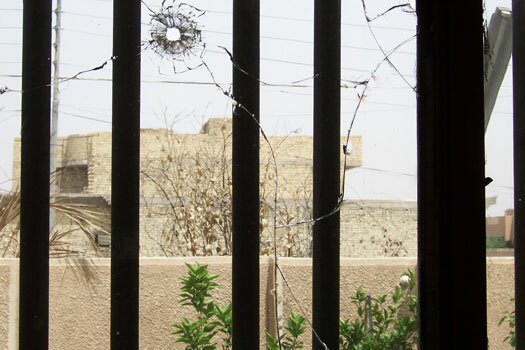
As I walked back to the car, another man tugged my arm and yelled, “The Americans are cowboys; this is their history! Look at what they did to the Indians! Vietnam! Afghanistan! And now Iraq! This does not surprise us.”
Along with the daily publication of photos documenting the atrocities occuring in Abu Ghraib, stories like these underscore what most people in Iraq now believe -- that the liberators have become no more than brutal imperialist occupiers of their country.
Fallujans Declare Victory!
Fallujah - The electricity in the air is palpable on this windy, grey day in this city that is slowly coming back to life. Everyone knows the Marines are rolling a symbolic patrol into the city today, as Iraq Police (IP) and Iraqi Civil Defense Corps (ICDC) are milling about every intersection on the main street. The street is blocked off -- and many people are watching from store fronts and windows to see what will happen.
Marines from the 1st Marine Division begin to roll several Humvees and Stryker vehicles into the tense atmosphere, in a laughable attempt to show cooperation with the IP and ICDC who are to take over patrolling the city for them. The negotiations are complete, and the tenuous truce finds the Marines here -- the sunglasses of soldiers peering out from holes on top of the Stryker combat vehicles, while others man machine guns on top of Humvees, nervously scanning the rooftops.
Of course they are being watched by more than just civilians, as they have their own backup at the overpass near the city -- I’d seen soldiers holding rocket launchers aimed into the city to cover the patrol in case fighting erupts.
The IP and ICDC that I speak with along the street all say the deal is for the marines to have one hour to visit the mayor at the Tribal Council building. Once the small convoy rolls behind the 8 foot-high concrete barriers that surround the building, leaving the IP and ICDC who were traveling all around them as an escort in the usual human shield fashion, an IP turns to me and says, “The Americans are not good people. We are here to take care of you.”
1st Lt. Eric Knapp, the Public Affairs Officer for the 1st Marine Division, in a press release about the exercise later stated, “Marines from the 1st Marine Division traveled into Fallujah today to exercise freedom of movement and meet with city officials.”
Abdul Rahman, a captain in the ICDC, says to me, “There were negotiations between the people of Fallujah and the occupation forces. The plan is for the Americans to pull all of their troops out of the city after they get this one patrol.” After pausing while looking at the military vehicles inside the concrete wall, he added, “We want them out of our country.”
In the press release, 1st Lt. Knapp also added, “Cooperation between Coalition and Iraqi Forces in Fallujah is symbolic of the solidarity between all who share a vision of a secure and prosperous Iraq.”
Nervous residents of the recently besieged city watched quietly from sidewalks as the vehicles sat for 30 minutes inside barriers surrounding the Tribal Council building. The building was also ringed by the scores of Iraqi police and security forces that had accompanied the patrol.
This “patrol” had traveled a daunting two miles from the highway bridge to this building, with full Iraqi escort. Is this a show of force? Is this an attempt to save face? If it is either of these, nobody I speak with throughout the day seems to think so.
Just outside of the building, Alla Hamdalide, a member of the ICDC said, “We brought the Americans from the bridge into the city. They couldn’t even come in here alone. The victory for Fallujah remains.”
After only half an hour inside the building, with scores of IP and ICDC riding in pick-up trucks surrounding the vehicles of the Marines, the patrol slowly makes its way back out of the city.
My translator, who is aware of the truce, assures me there will be no fighting unless the Marines start it. Nevertheless, I scan around for something to hide behind if it does…the normally busy street is a surreal quiet, and has the tangible air of expectancy for bloodshed that the people of Fallujah have come to know all too well.
As a Humvee passes, a resident of Fallujah turns to me and says, “I am uncomfortable with the Americans being here. We dislike them.”
A few people wave at the Iraqis that are accompanying the patrol, who tentatively wave back to them. I spot a couple of soldiers who, thinking the waves are for them, wave back as well.
Once the patrol is about a half mile from the area, spontaneous celebrations erupt as crowds of residents flow into the street. Iraqi flags appear everywhere as people begin chanting and waving them wildly. Members of both the Iraqi Police and Iraqi Civil Defense Corps who were at the intersections join in the celebration, waving their guns in the air and giving the “Victory” sign.
A parade is quickly formed…cars honking, trucks with boys and men riding in the backs of them line up, and the Iraqi Police who were there to guard the Marines have promptly turned into parade escorts, as well as participants.
As the ruckus begins to inch down the street, an elderly Fallujan resident riding in the back of a truck waving an old Iraqi flag yells, “Today is the first day of the war against the Americans! This is a victory for us over the Americans!”
Mujahedeen brandishing Rocket Propelled Grenades (RPGs), Kalashnikovs and hand grenades are paraded on trucks as thousands of residents begin to move up and down the main street in the victory parade amidst loud music blaring from the minarets of mosques.
Ahmed Saadoun Jassin, an Iraqi Policeman, smiling from ear to ear, says, “I can’t describe to you the happiness I feel right now. This is a victory for Islam.” Many of the IP’s and ICDC are holding their weapon in the air with one hand while giving the victory sign with their other.
When I ask about cooperating with the Marines, Mr. Jassin says, “This was the deal that was negotiated. They couldn’t stay in Fallujah for over one hour, which they didn’t.”
I am pulled up into the back of a pickup truck as we are being pelted by candy thrown by shop-owners throwing handfuls of candy at the crowds who pass. Many of the people celebrating continue to wave Iraqi flags, while some hold up the Koran.
Vehicles carrying both armed mujahedeen and celebrating residents of Fallujah roll up and down the main street of the city. Members of the IP and ICDC are firing their guns into the air, along with several mujahedeen. Men are holding children in the air, many of them giving the victory sign while holding candy in their other hand.
The press release for the 1st Marine Division about the patrol states, “Fallujans reportedly waved to the Marines as they made their way in and out of the city. Freedom of movement in Fallujah, like that demonstrated by today’s visit, is a crucial component in the process of setting the conditions necessary to rebuild and revitalize the city. This display of teamwork serves notice to those who violently oppose stability in Iraq; they are nothing more than unwanted barriers on the road to a truly free Iraq.”
A mujahedeen fighter riding on the roof of a truck while wielding an RPG stated, “They (Marines) just made the people of the world laugh at them. But I think they will come back, because they don’t keep their word.”
The celebrating continues throughout the day…for while the parade disperses after a couple of hours, small groups of honking cars carrying Iraqis waving flags triumphantly continue to buzz around the streets. Children are running around with flowers, carrying them towards mosques. People are speaking of more celebrations tonight.
Boys have set up water and juice checkpoints -- giving cups of juice to cars that slowly pass through them, and waving flowers about as they play in the sun which has come out.
Despite suffering tremendous loss during the fighting in April, the battles have apparently galvanized the will of the residents of Fallujah, who, at least today, are relishing their newfound freedom from the occupiers of their city.
Story and Pictures of Falluja Victory Celebrations
Remember last April, when US Marines knocked down a famous statue of Saddam Hussein, a couple of hundred Iraqis came out to celebrate, and the US media made a major event out of it? Today's media stunt by the Marines was a symbolic convoy driven to the heart of Fallujah. After the Marines left, thousands upon thousands of residents of the defiant city, joined by mujahideen fighters and US-trained Iraqi police and soldiers, poured into the streets to celebrate what Fallujans saw as their "victory" over US forces in the battle for their city.
Just as the Western media exaggerated last year's celebrations, they are systematically downplaying today's.
But NewStandard correspondent Dahr Jamail was there, and he wrote the story and took the photographs that should appear on the front pages of newspapers across the US tomorrow morning. The story he gathered -- standing among the people who watched the Iraqi-escorted convoy pass, and even talking to Iraqi soldiers and police -- differs dramatically from the version told by Marines and the Western journalists "embedded" with the convoy.
And we've posted here some extra photos that didn't fit in the article...


All photos are copyright © Dahr Jamail, The NewStandard, May 10, 2004. Please contact TNS for reprint permission. High-resolution versions available on request.
May 09, 2004
Human Shields, Fighting, More Bombs
With the horrendous security situation limiting movement of the media in Iraq more than ever before, many of the attacks and bombs against the occupiers are going unreported.
Everyday now in Baghdad I hear bombs going off, along with the usual sporadic gunfire in the streets. The majority of the explosions come from inside the so-called “Green Zone.”
The U.S. military in Iraq, apparently determined to keep as many fronts open as possible in their war, attacked the office of Muqtada Al-Sadr in Sadr City yesterday afternoon. Of course this was followed by fighting last night, and yet more today.
Fighting continues to spread throughout the south today in Basra, Najaf, Kerbala, Amarra -- many people now feel the situation is headed back to where it was a few weeks ago: rampant fighting, and an even further deteriorating security situation for foreigners.
My friend Sheikh Adnan from Baqubah told me that three days ago in his city, the office of the Patriotic Union of Kurdistan (PUK) decided to fly the new “flag” of Iraq, which has only one of the four colors of Islam (lacking black, green and red). It was decided upon behind closed doors by the U.S.-appointed Governing Council, with no vote of the people. It bears a light blue crescent, two light blue lines representing the Tigris and Euphrates, and a yellow line between them to represent the Kurdish population.
There is nothing in the flag which represents the Arab population, who comprise the majority of Iraq. The Sheikh has written in his new book that the Kurdish certainly have a right to be represented in the flag, but only if the Arabs are as well.
I have yet to talk with one Iraqi who is happy with the new “flag.”
So the flying of the new “flag” in front of the PUK building of Baqubah went over well -- within 24 hours a car bomb destroyed much of the building, and of course the “flag.”
I have yet to see the new “flag” anywhere, aside from seeing it burned in Fallujah. Anywhere it is flown, it is promptly torn down. Nobody would dare hang one in their car.
The residents of Al-Adhamiya, Baghdad, responded to the new “flag” by hanging countless flags (the real flag) all over their neighborhood. A huge version, over 20 meters long, was hung near Abu Hanifa Mosque. Smaller versions of the flag are fluttering from buildings, homes, and even paper versions are hung inside cars.
The U.S. military responded by coming to the area and tearing down as many of them as possible. One was rolled over by a tank. As usual, dissent in occupied Iraq is dealt with by tanks and guns.
This is the freedom. This is the democracy.
Of course the people of Al-Adhamiya responded by hanging even more flags up. My translator and I decided it was a good time to pick one up for each of us as well.
Another development of note is that recently U.S. patrols and convoys have allowed cars to drive near them, as well as between their Humvees and Bradleys. This was never allowed before – previously, when they were on the streets you could always expect a traffic jam, as they would not let a single car pass, or even get near them.
So now the military is using Iraqis as human shields on the streets and highways in an effort to protect themselves from attacks by the resistance. Everyone I’ve spoken with about this is aware of the military’s tactics.
This is just as they intend to do in Fallujah when U.S. patrols are resumed there: to use the Iraqi Police (IP) and Iraqi Civil Defense Corps (ICDC) to buffer themselves against the attacks that are sure to come, even worse than before.
I saw them use this method in Samarra last January. A U.S. military patrol creeping down the main street towards the Golden Mosque, with soldiers walking behind Humvees. On the sides of the soldiers, literally walking between them and the people on the sidewalks, were Iraqi Policemen.
Ever wonder why so many IPs have died during the occupation?
May 07, 2004
"We will fight them again!"
An older Iraqi man is wailing near the grave of a loved one in the dusty heat of a football stadium converted into a cemetary. Between wails he raises his fist and yells, “Allahu akbar!” (God is great).
We wait outside until he slowly exits the new cemetery with his brothers holding him.

Rows and rows of fresh graves fill the football stadium in Falluja. Many of them are smaller than others. My translator Nermim reads the gravestones to me: “This one is a little girl.” We take another step. “And this one is her sister. Next to them is their mother.”
We walk slowly under the scorching sun along dusty rows of humble headstones. She continues reading them aloud to me: “Old man wearing jacket with black dishdasha, near industrial center. He has a key in his hand.” Many of the bodies were buried before they could be identified. Tears are welling up in my eyes as she quietly reads: “Man wearing red track suit.” She points to another row, “Three women killed in car leaving city by American missile.”
One of the football stadiums in Falluja has become a Martyr Cemetery due to the hundreds of deaths caused by the fighting throughout April. U.S. marines eventually surrounded the main cemetery, so the residents of Falluja had to bury their dead here. Iraqi doctors estimate that over half of the dead Iraqis are women, children and elderly, and the graves I view seem to confirm this. There are nearly 500 graves here today, and counting...
As we walk back to the car the loudspeaker of a nearby mosque is blaring the words of an Imam: “We have two reasons to be happy this month. One is the birthday of our prophet. The second is our victory over the Americans!”
I weep at the cost.
Over at another mosque a little earlier, under the constant buzzing of unmanned military surveillance drones, the mood was more defiant. The rumor is going around that the Marines will resume patrolling the streets of Falluja this coming Monday, along with Iraqi Police (IP) and the Iraqi Civil Defense Corps (ICDC). Yet this rumor is being widely circulated by both the IP and ICDC.
Abdul Muhammed tells me, “When the Americans start patrolling on Monday, even more people will fight them this time because so many people need revenge now.”
Another man angrily states, “They try to cover their failure by these patrols. We will fight them again!” He continues sternly, “We don’t want them in our city! Nobody in Falluja wants to see them in our streets! Everyone who lost family to them will avenge them!”
This discussion takes place standing in the rubble beneath a minaret that has been blasted by either a missile or tank -- a gaping hole just below the top. After climbing up the spiral stairs as high as possible, two men join me to look out over the city that resembles more of a ghost town. There is so much more destruction than the last time I was here a few weeks ago.
One of the men, who speaks English, says, “I saw American snipers shoot a woman on her roof while she was hanging her clothes. This was during their cease fire.”
I hear more horrible stories of snipers killing civilians today than I can keep track of. After carefully making my way back down the rubble covered steps, we drive to the Julan area of Falluja, which was very heavily bombed during the fighting in April.
The tight streets and numerous alleys of Julan are mostly empty after we pass through two mujahedeen checkpoints. So many homes are bombed, others riddled with bullets. Date palms are torn down and the stench of rotting bodies hangs in the air.
There is a huge crater, at least 8 feet deep and three times that at its diameter, just in front of a small mosque. The hole is partially filled with water from a leaking pipe below. People sit inside the mosque listening to their Imam. As I take photos several men gather around.

One of them states, “I hope the Americans come back on Monday. They killed my cousin and burned my house. God gave us the victory, and He will give us another when they come back!”
Another man points to the mosque and says, “Marines entered this mosque before they bombed it and slit the throats of refugees. This is their democracy? This is their freedom?”
One of the other stories going around Falluja is that of Marines using mosque minarets to shoot at people. Every group of people I speak with at each location is stating this. True or not, it is what people here believe. The damage is done. These beliefs, cemented by the recent photos coming out of Abu Ghraib, have melded distrust and hatred into a long sword which is now held against the occupiers.
Driving a little further into Julan we pass a scorched ambulance on the side of the road.

At yet another mosque I am shown a copy of the Holy Koran which has two bullet holes through it. Another man, walking from a minaret that has been completely demolished, shows me casings from a tank shell.
Aziz Hussein, who was in Falluja for much of the fighting, tells me of the horrible bombings by U.S. war planes, but that all of Falluja was together in supporting the mujahedeen. He says, “When someone lost one of their family or their home, they didn’t blame the mujahedeen. Most of the people killed by bombings were civilians. Americans said the civilians were killed by mujahedeen, but this is just not true.”
He too tells the story of Marines shooting people from minarets, “When we tried to go to our mosque, the snipers shot at us.”
I hear more horrendous stories: Marines occupying people’s homes and looting them of money and gold, leaving feces in their foodstuffs, butchering their cows, chickens and dogs.
Later as we prepare to leave, a man tells me, “The mujahedeen will shoot the Americans as soon as they start their patrols here. Falluja is our city, not the Americans’!”
May 06, 2004
No Apology, Car Bomb, "I am your God."
At roughly 7:30 this morning I was awakened by a huge explosion that rocked my hotel building. I can tell how close they are now by how much I feel them through the floor.
If they are further away, they just rattle the windows a bit. This one I felt through the floor. The walls shook, and brought that usual feeling of dread in the pit of my stomach which accompanies the thought that several human beings have just been blown to pieces.

My colleague Dave Enders and I quickly gathered our cameras, notepads, and press credentials and caught a cab following the huge plume of black smoke billowing from the direction of the CPA.
At the checkpoint near the 14th of July suspension bridge that spans the Tigris, huge flames reached into the morning sky from a car between two large concrete walls that lead to the checkpoint, roughly 15 meters away from the entrance to the ‘Green Zone.’ Several cars behind it were crushed by the bomb. Glass was everywhere.
Soldiers angrily ordered the crowd to stay back from the razor wire they’d pulled across the streets in front of their Humvees.
A fire truck feebly sprayed water onto the incinerated vehicle; the flame always reignited, smoke spewing out the sides. The flames twisted agonizingly in a spiral creating a hellish tornado.
Glass in all of the surrounding buildings had been blown out, along with that of several cars along the street.
A leg was found 200 meters from the blast site. Broken glass covers the grass near the line of blasted cars.
The scene rocked with another small explosion, perhaps a gas tank going off from another car in the line. Iraqis crowded near the razor wire reflexively moved backwards fearing another bomb. Ambulance sirens blared, soldiers yelled at people who got too close, and the overall feeling of doom and sadness pervaded the hellish scene.
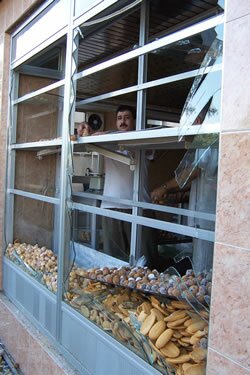
We caught a cab to go back to the hotel, and the cab driver angrily stated, “Before with Saddam, we had no bombs like this. Now with American, this is the democracy!”
Meanwhile intense military operations have occurred very close to the sacred Imam-Ali Shrine in Najaf, as the coalition attempts to take advantage of growing anger towards Muqtada Al-Sadr from more moderate Shi’ite clerics in the region. At least one U.S. soldier and 15 Iraqis have died in the fighting thus far.
As the Bush Administration scrambles for damage control from the stream of photographs documenting the atrocities from Abu Ghraib prison, atrocities in Iraq under the brutal occupation continue.
Mr. Bush, appearing on the U.S.-funded Al-Hawra Arab Television Station, failed to apologize to the Arab community, leaving this for his aides. Of course this is what many Iraqis today have mentioned -- not that he scorned the acts of torture, but that he didn’t even apologize.
One of my Iraqi friends told me, “This shows he doesn’t care about Iraqis. All he cares about is himself and the image of America. What is the image? That America has brought us freedom and democracy? Does he think we are stupid and blind?”
Lately it seems as though every Iraqi I speak with about these photographs of Iraqi detainees being tortured and humiliated has an air of deepening resignation to the idea that the bringers of democracy have brought anything but.
Last night in Al-Adhamiyah I was interviewing a group of men who were detained on February 25th when their shop was raided by U.S. troops. One of them, Abdel Hamid Majed, claimed that his hands were tied tightly, a sack was placed over his head, and he was forced to lay on his stomach inside a shop for six and a half hours while the soldiers were deciding what to do with them.
He said, “We were whispering, ‘Allahu Akbar’ to sustain ourselves, and the soldiers were laughing at us.”
After laughing at the detainees for praying, Abdel (who speaks English) said, a soldier standing over them asked, “Do you want to pray? Pray to me. I am your God.”
Later several of the men were taken to Abu Ghraib. On April 20th, one of the men detained, Dr. Oubaidy Nezar, (a doctor of Physical Chemistry), died at Abu Ghraib prison.
May 05, 2004
Iraqi Police?
Along with an in temperatures here in Baghdad, there is an accompanying increase in tempers where the unfulfilled promises made by the U.S. to rebuild and rehabilitate Iraq are coming more into focus with each passing day. Daily life is a struggle for most Iraqis, and it isn't helped by the brutal occupation or by the corrupt police department.
That I can come and go from Iraq always makes me feel, well, that I have this ridiculous, unearned privilege simply because I was born in another country.
Even more, that I get short tempered and outraged by things that Iraqis seemingly take in stride on a daily basis... what can I do besides laugh at myself?
While driving towards Al-Adhamiya, a Sunni neighborhood of Baghdad from which I’ve reported several times, my translator and I were pulled over at an Iraqi Police checkpoint. After a long exchange and much arguing, the car was impounded, despite the fact that all of the necessary paperwork was at hand... well, now it is in the hands of an Iraqi 'Policeman' (IP).
The policeman wanted money. Abu Talan wouldn't pay. We were forced to follow an IP to the lot, drop the car, and take a taxi back to try to find the IP with Abu Talans' papers. After much looking around, we spotted him, followed him, and regained the papers.
Now all we need is the car, which Abu Talan fears will be looted tonight.
I've often read the stories telling of how many of the IP's are Ali Baba (thieves), and simply use the uniform to take advantage of people. It's always a different thing to run into it. Pretty unbelievable that this occurs, despite the fact that the IP's have to pass a rigorous, 18-day training period instituted during the coalition's desperate attempts to hand 'security' back over to the Iraqis before the arbitrary June 30 "handover."
So there is that privilege thing again -- despite working on horrendous stories about detainees being tortured horrifically by U.S. soldiers, dealing with corrupt IPs can still get me worked up.
Forgetting that Iraqis have to live with this -- and there is no change in sight.
Yesterday driving down the highway we passed a U.S. patrol traveling in the opposite direction. One of the trucks carried soldiers wielding their guns in the usual way: aiming them at all of the passing traffic. The soldiers had plywood around them as they stood in the back of the truck. On the plywood was spray painted, "South Carolina Killers."
When do we choose to stop calling the brutal occupiers "liberators," and begin calling them the names associated with their actions: Killers (let's start by using one they choose to call themselves), Torturers, Looters, Occupiers, Rapists, Extortionists.
Sounding a bit harsh? I'll qualify this by saying that I do believe the majority of U.S. soldiers in Iraq are doing their best, trying to do their job and get home in one piece.
But there is a significant percentage who fit the aforementioned labels... for I, along with several other journalists, activists, and human rights organizations have written stories documenting countless examples of each.
When do we choose to begin calling this occupation a failure? The occupiers have to hide behind concrete walls 20 feet high. They are shelled nightly in many of their bases. They drive the streets afraid of sustaining an attack at any time.
Reconstruction (what there was of it) has ground to nearly a complete halt.
We focus on the torture now, while nightly the Coalition Provisional Authority compound across the Tigris is bombed. Just last night I heard several explosions there. My friend Dave calls their press office after our windows stop shaking to ask them where they were hit. The reply? "We don't know. We're checking on that."
If they could only be as honest regarding the entire occupation.
Sadiq Zoman Torture Story Released!
After days of research in Baghdad and stateside, The NewStandard is proud to present Iraq correspondent Dahr Jamail's thorough report on the story of Sadiq Zoman, who apparently underwent torture while in US Army custody. The NewStandard and Dahr Jamail intend to follow up on this case, as well as pursue some of the hundreds of others being talked about all over Iraq. Public pressure and demands for answers may be the key to forcing explanations, accountability and changes in how soldiers and Marines treat Iraqi prisoners.
If you find this story compelling, please forward this article widely, or use the "send-to-friend" feature on our website to pass it along with the moving graphics that accompany the story. We are trying to push this story far and wide as we believe the questions it raises deserve honest answers, as much as we believe the world deserves to know the Iraqi side of the occupation story.
Telltale Signs of Torture Lead Family to Demand Answers
May 03, 2004
Tortured Souls
I haven't written anything to my blog for several days now. Stories in Iraq have a tendency towards determining themselves, and the one I've been working on has taken on new meaning this second time around.
It was last January when I came upon the horrendous story of Sadiq Zoman. In short, he was detained by U.S. soldiers last July from his home in Kirkuk. While in U.S. military custody, he was beaten, tortured with electric shock, whipped, one of his hands was broken, his head was bludgeoned, and he was dropped off comatose to the General Hospital in Tikrit a month later.
I wrote a very rough version of the story in my diary which was posted on electronicIraq.net.
My hopes in doing so, aside from attempting to bring attention to what most Iraqis already know about the atrocities committed against detainees in Abu Ghraib Prison and many of the other U.S. detention facilities in occupied Iraq, was to bring some attention to his family in the form of compensation.
This time around, rewriting the story now that more media have finally chosen to show these International Crimes, my hope is the same.
So I poured much of myself into more deeply researching the story. Collecting documents, calling people, and most importantly, getting to know his wife and 9 daughters while doing so. Because behind every torture victim there are loved ones. Behind every hooded Iraqi you see in those horrific images there are wives, sons, daughters, brothers, sisters, mothers and fathers.
Behind those pictures you see of Sadiq Zoman's bludgeoned head and comatose eyes is a wife who is weeping every day as she fans him to keep him cool when there is no electricity for 18 out of every 24 hours in their bare home. It is bare because nearly all of their possessions have been sold to purchase his medicines.
Behind the photos of electrical burns on the bottoms of his feet are 9 daughters who work to care for their father. Mr. Zoman, who was once a large, strong man, lies in his meager bed, his wife and daughters taking turns manually pumping mucus from his stomach, or blending his food to feed him when the electricity is on.
Most of the rooms in their home in Al-Dora, Baghdad are literally completely bare. There is no car, there is no phone. There is simply no money. If nothing changes for them, they could be on the street soon.
Yesterday evening in their home, one of his daughters said, "Even if millions of people read this story, what will they do? It can't bring my father back. They will be sad and upset to read it, but what will it change?"
Another of his daughters who is in the college of medicine in Baghdad, continuing her studies until her paid tuition expires, told me, "You see our life here. How can we keep living like this? Where is the hope?"
I'm not under the illusion that writing this story can change anything. But I'm an idealist, and I want to bring...what? Justice? Hope? Help for them? Accountability? An end, or at least an ease to this suffering?
All of these. But hope is in short supply in occupied Iraq. And bringing that word up to people in such a horrendous situation is a dangerous prospect.
I don't know what else to do beyond writing this story that you will soon read. But what I am doing is helping them to go through the process of filing compensation request forms through the CPA...in hopes that the U.S. military will provide some financial compensation for this family who so desperately needs it. The odds are very much against them that they will receive one Iraqi Dinar for this hell they've been living through for nearly a year now.
So I put it out to whoever might read this, and the story. Will you be outraged? Upset? Angry? Saddened?
Probably.
My next question then, is this:
What are you going to do about it?
After several days of laborious research both in Iraq and stateside, the incredible story of Sadiq Zoman and his family will appear on The NewStandard website on Tuesday, May 5.